What Are Your Real Loan Options with a 400 Credit Score?
13 Min Read
 Reviewed by Michael Lefler
 You can get approved for several types of loans with a 400 credit score if you have sufficient income and meet the lender’s other requirements. However, not all lenders will approve you, and you are likely to get higher interest rates and fees, shorter repayment terms, and lower loan limits.
Key Points
- A 400 credit score is considered poor on both FICO and VantageScore scales. That means your loan options will be limited, and the products available to you will carry higher costs.
- People with 400 scores may qualify for certain loan types, including bad credit personal loans, auto loans, federal student loans, secured loans, cosigned loans, payday alternative loans, BNPL, cash advance apps, and payday loans.
- Some loan types will require you to make a down payment, provide collateral, or add a cosigner to strengthen your application.
What Are the Factors That Determine Your Credit Score?
The exact factors used to calculate your credit score depend on the credit scoring model. There are two major models: FICO and VantageScore. Both consider similar factors, though they weigh them differently. Here’s what makes up your FICO score:
- Payment history (35%). Your payment history shows how you manage your bills and loan payments.
- Credit utilization (30%). This factor shows your overall credit usage compared to combined credit card limits.
- How long you have had credit (15%). A long credit history gives a more complete picture of how well you manage your finances.
- Credit mix (10%). A diverse credit mix reflects your ability to manage both installment and revolving credit accounts.
- New accounts (10%). New accounts affect your credit score by shortening your length of credit. Opening a new account may also involve a hard inquiry that can drop your credit score by less than 5 points each unless you shop around for one loan type within 14–45 days.
Is 400 a Good Credit Score?
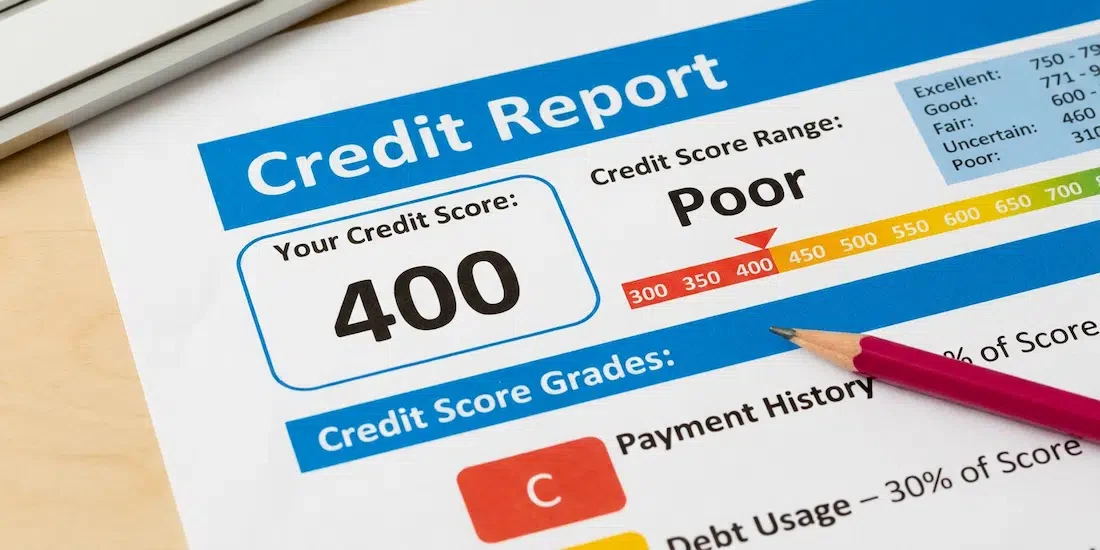
A 400 credit score falls in the “poor” range on the FICO scale and “very poor” on VantageScore. Here’s where it sits on both scales:
| Ranges | FICO | VantageScore |
|---|---|---|
| Very Poor | – | 300–499 |
| Poor | 300–579 | 500–600 |
| Fair | 580–669 | 601–660 |
| Good | 670–739 | 661–780 |
| Very Good | 740–799 | – |
| Exceptional/Excellent | 800–850 | 781–850 |
How a 400 Credit Score Impacts Your Finances
Low credit scores put you in the “risky” category, making it difficult to get approved for traditional loans. Even if you qualify, you are likely to get less favorable loan terms. Besides the ability to get a loan, a 400 credit score can result in a higher security deposit and limit your options when renting a home. People with poor credit are also likely to get higher insurance premiums or have trouble getting hired for roles that require financial responsibility and management.
Loan Options for a 400 Credit Score
Below are common types of loans you can get with a credit score as low as 400.
Bad Credit Personal Loans
While you are unlikely to get a traditional personal loan from a bank if you have poor credit, it’s possible to find alternative lenders with no minimum credit score requirements. Instead of relying on your credit, they evaluate your income, employment history, existing debts, and ability to repay. However, it may be difficult to find a lender offering unsecured loans to borrowers with poor credit.
Auto Loans
Many auto loans do not have minimum credit score requirements. Since they are specifically designed for a vehicle purchase, the car or RV you buy serves as collateral and can be repossessed if you default. As with most loans, a low credit score means you will get a higher APR on your auto loan. Some lenders may also ask for a down payment.
Federal Student Loans
Except for PLUS loans, federal aid is provided based on need, dependency status, enrollment status, program of study, cost of attendance, and year at school. It involves no hard credit inquiry and does not rely on your score. Also, your credit does not affect your interest rate, as it is determined based on the loan type and the first disbursement date of the loan.
Secured Loans
Secured loans require you to pledge a valuable asset that will be used as a repayment guarantee. Lenders have the right to seize collateral if you fail to repay the loan. The most common types of collateral are a house, a car, jewelry, investment or crypto holdings, and other assets that can be physically retained to recoup losses.
Avoid high-interest secured loans, such as car title loans. In addition to their triple-digit APRs, they also have short repayment periods, typically 30–60 days. This increases the risk of losing a car, especially if you are already in financial trouble.
Cosigned Loans
If you do not want to risk your property, a cosigned loan may be an alternative. This option requires a cosigner on your application. The cosigner shares responsibilities with the primary borrower but cannot access the funds or own assets purchased with the loan. Although not very common among lenders, these loans are still available to borrowers with scores in the 400s. However, a cosigner needs to have a credit score of at least 670 for better approval odds.
Payday Alternative Loans
Payday alternative loans (PALs) are offered by federal credit unions to replace predatory lending products that often remain the only option for people with bad credit. These loans are regulated by the National Credit Union Administration. There are two types of PALs available. Both cap APRs at 28% and application fees at $20, though amounts and repayment terms vary (see the “What to Expect” section for more details).1
Buy Now, Pay Later (BNPL)
These loans are offered through certain services or apps available at checkout or online in your cart. They allow you to split the cost of your purchase into 4 bi-weekly payments, with the first one often due upfront. So the repayment period typically runs up to 6 weeks.
Most BNPLs have a 0% APR as long as you pay on time and do not require a hard credit inquiry. However, late fees may reach 25% of the order value and be reported to credit bureaus by some providers.
Cash Advance App Loans
Loans via cash advance apps are available to employed individuals regardless of their credit scores, but they require an active checking account, regular direct deposits, and employment verification. These apps provide you with early access to a portion of your already earned paycheck. While offering relatively small amounts, they usually advertise a 0% APR. However, express and subscription fees may push the effective APR well above 100%.
Payday Loans
Payday loans are high-risk options for borrowers with poor credit. Despite the “small fee” illusion (lenders typically charge $10–$30 for each $100 borrowed), their APRs range from 261% to 782%. Additionally, these loans are repaid within a short period, usually by the borrower’s next paycheck. Together, these factors create a real risk of a debt cycle.
According to the 2014 CFPB research, 80% of payday loans are rolled over or followed by another loan within 14 days. Therefore, many states strictly regulate or completely ban payday lending. In addition, the Military Lending Act (MLA) protects active-duty service members and their dependents by setting interest rate caps at 36%.
Before applying for a payday loan, consider lower-cost alternatives first. Check your state regulations to understand the rules and caps, and only get these high-interest loans in a real emergency and when other options are unavailable.
What to Expect: 400 Credit Score Loan Rates, Fees, and Terms
The numbers are estimates and may vary depending on the lender, state, income, and other factors.
| Loan Type | Loan Amounts | APRs | Fees | Repayment Terms |
|---|---|---|---|---|
| Bad Credit Personal Loans | $250–$50,000 | Up to 35.99% | Origination, late, prepayment fees | 12–60 months (up to 84 months for some lenders) |
| Auto Loans | Up to 100% of vehicle price | 21.58% avg | Document, origination, car registration fees, and prepayment penalties | 24–84 months |
| Federal Student Loans (excl. PLUS) | $5,500–$50,000/year | 6.39%–7.94%2 | Origination fees | Up to 10 or 30 years |
| Secured Loans | Up to 90% of collateral value | Up to 35.99% | Origination, appraisal, and late payment fees | 12–84 months |
| Cosigned Loans | $1,000–$100,000 | Up to 35.99% | Processing and late fees | 12–84 months |
| PAL I | $200–$1,000 | Up to 28% | Application fees | 1–6 months |
| PAL II | Up to $2,000 | Up to 28% | Application fees | 1–12 months |
| BNPLs | $50–$1,500 | 0% pay-in-four if on time; up to 36% long-term | Late fees are common | Up to 6 weeks (6–24 month options less common) |
| Cash Advance Apps | $20–$750 (up to $1,000 some) | Often 0% | Express, subscription, and membership fees | 14–30 days |
| Payday Loans | $100–$1,000 | 391% (average) | Origination, late, and non-sufficient funds fees | 14–30 days |
How to Improve Your Credit Score
Fixing your credit takes time and patience, but it is worth the effort. Since your credit score usually updates once a month, you can see a small positive impact within 30–45 days after taking the first steps. Rebuilding your credit from 400 can take you several years. Here’s what you can do to get started:
- Review your credit reports for errors. Common inaccuracies that may appear in your credit reports include math mistakes, mixed credit files, or misreporting due to similar names or Social Security numbers. Monitoring your credit reports will help you detect and dispute them early. Free weekly copies of your credit reports are available through AnnualCreditReport.com or directly from each of the three major credit bureaus (Experian, TransUnion, and Equifax).
- Pay your bills on time. Payment history is a primary factor that scoring models rely on when calculating your credit score. A single payment made 30 days late or more can drop an excellent credit score by 60–80 points. Paying on schedule helps you rebuild and maintain good credit in the long run.
- Do not use your credit cards to their limit. Experts recommend keeping balances at no more than 30% of your available credit limit, and under 10% for the best impact on your score.
- Pay off debts. If you have any past due accounts or debt in collections, start by paying them off. Keep in mind that if a collector contacts you, you have the right to request debt validation within 30 days (FDCPA §1692g) and cannot be jailed for unpaid consumer debt.3
- Report on-time bill payments. Services like Experian Boost allow you to raise your credit score for free by adding information about your on-time utility, cell phone, rent, and insurance payments to your credit report.
- Take out a credit-builder loan. This loan helps you build both credit and savings. The amount is locked in a separate account while you make payments on schedule. Once the loan is repaid in full, you get access to the funds. Payments are reported to credit bureaus (one or several, check with the lender), helping you establish positive credit records.
- Apply for a secured credit card. A secured card provides you with the limit you deposit upfront. Then, you can use it just like a regular credit card. By using credit responsibly, you can boost your score and upgrade your secured card to an unsecured one with a higher limit.
- Create a debt-management plan. If you struggle with high-interest debts, turn to non-profit credit counselors who will work with you on a manageable repayment schedule. The National Foundation for Credit Counseling’s specialists can help you settle your debts with creditors, negotiate lower interest rates, and pay off your loans or credit cards faster.
FAQ
What is the easiest loan to get with bad credit?
Payday loans are considered one of the easiest to get with poor credit. However, they have very high interest rates and short repayment terms, so consider them only as a last resort.
How fast can I raise a 400 credit score?
It depends on your behavior, financial situation, what’s currently damaging your credit, and the results you expect. You may see initial improvement within 30–45 days of taking the first steps (paying off debts, lowering credit utilization, etc.). Raising your 400 score to 600–700 can take a year or more.
Credit-builder loan vs. payday loan — which is less predatory at 400?
A credit-builder loan is not a predatory loan option. Although it does not provide you with the borrowed amount in hand right away, it allows you to boost your credit and build savings. Payday loans usually do not help your credit score and carry high APRs and fees. Therefore, they are riskier and less consumer-friendly.
Can I get a mortgage with a 400 credit score?
You are unlikely to get approved for a mortgage with a credit score that low. Conventional mortgage lenders commonly require a minimum credit score of 620. FHA loans have a minimum requirement of 500. USDA loan originators must obtain verification of rent or mortgage and an explanation letter for derogatory credit if an applicant has a credit score below 620–640, making it difficult to qualify with a score of 400. While VA loans have no minimum credit score requirements, private lenders offering them still check credit to assess a borrower’s eligibility and want them to have a minimum credit score of 550–620.
Submit your application to see what you can qualify forApply Now
Sources
- 1 National Credit Union Administration — 12 CFR § 701.21 – Loans to Members and Lines of Credit to Members — PAL APR and application-fee caps. 2025.
- 2 U.S. Department of Education, Federal Student Aid — Annual Notice of Interest Rates for Fixed-Rate Federal Student Loans. March 2026.
- 3 Office of the Law Revision Counsel, U.S. House of Representatives — 15 U.S.C. § 1692g – Validation of Debts — debt-validation rights. 2024.